Physical Address!
Globlar OÜ Harjumaa Tallinn, Estonia!
Physical Address!
Globlar OÜ Harjumaa Tallinn, Estonia!
Norway is bigger than most Americans expect. It stretches roughly from the latitude of southern Alaska all the way to the Arctic Ocean and the postcard views you saved on Pinterest are hundreds of miles apart. So if you only have one shot at this trip. Where should you actually go?
That’s the question I wanted to answer. I compared what the top-ranking Norway guides agree on looked at which places keep showing up in every serious list and narrowed it down to five. Each one gives you a completely different Norway: a world-class city and a fjord town a fairy-tale fjord an island chain at the edge of the Arctic and the northern lights capital.
Stay with me to the end because the fifth stop is the one most first-timers get wrong (and the timing tip in it can save your whole trip).
|
Place |
Best for |
Best time to go |
Time to allow |
|
Oslo |
Museums, architecture & city life |
May to September |
2 to 3 days |
|
Bergen + Flåm |
Fjords, trains and old town |
June to September |
3 to 4 days |
|
Geirangerfjord |
Waterfalls, cruises and viewpoints |
June to August |
1 to 2 days |
|
Lofoten |
Hiking, villages and midnight sun |
June to August (aurora: late Sept to March) |
4 to 7 days |
|
Tromsø |
Northern lights, winter fun |
November to March (aurora season runs late Aug to early April) |
3 to 5 days |
Before we get into each place, here’s a quick reality check that will make the rest of this article way more useful.
Most “best places” lists skip this part and it’s why people end up with exhausting itineraries.
Norway has two completely different travel seasons. Summer (June to August) gives you long days open mountain roads and green valleys. Winter (roughly November to March) gives you snow polar night and the best shot at the aurora. Several places on this list are great in one season and a poor fit in the other.
Distances are real. Oslo, Bergen Lofoten and Tromsø are not a quick drive apart. You’ll fly between some of them take scenic trains between others and that’s part of the fun.
It’s expensive. Most 2026 budget guides put mid-range travel somewhere around $150 to $250 per person per day and the estimates vary a lot depending on who you ask. Food and hotels are the big costs. I’ll share ways to cut that down near the end.
Got it? Good. Let’s start with the easiest place to begin.
Best for: art, architecture and first-time visitors How long: 2 to 3 days
Oslo is the city people plan to “just pass through” and then wish they’d stayed longer. The waterfront has been rebuilt over the past two decades and the result is one of the most interesting urban walks in Europe.
Walk on the roof of the Opera House. The white marble building slopes straight into the fjord and you’re meant to climb it. It’s free and it’s one of the best views in the city. Go near sunset if you want fewer people.
See The Scream at MUNCH. The 13-story Munch museum opened in 2021 on the waterfront and holds the world’s largest collection of Edvard Munch’s work. Several versions of The Scream exist and they rotate on display to protect them from light. The National Museum also shows a version. So art fans can see more than one.
Wander Vigeland Park. Over 200 sculptures and it’s free. Early morning is best.
Take the ferry to Bygdøy. This peninsula is home to the Fram Museum (a legendary polar ship you can board) and the Kon-Tiki Museum.
Here’s something older guides won’t tell you. The famous Viking Ship Museum is closed while it’s rebuilt as the Museum of the Viking Age and it’s not expected to reopen until 2027. In the meantime the Historical Museum in the city center is the best place for Viking history. If seeing Viking ships is the main reason you’re going to Oslo plan your trip for after it reopens and check the official site first.
Oslo is pricey, but a lot of the best stuff costs nothing: the Opera House roof, Vigeland Park the fortress grounds and the fjord itself. If you plan to hit several museums in a day the Oslo Pass (which also covers public transit) can pay for itself.
Oslo is the easiest Norwegian city to reach from North America. The flight from New York is roughly 8 hours, and several U.S. gateways have nonstop service. Check current schedules since routes change from season to season.
Next up: the city that sits at the front door to Norway’s most famous fjords.
Best for: fjord access, scenic trains and history How long: 3 to 4 days (including a fjord day trip)
Bergen is a colorful harbor city surrounded by seven mountains and it’s the most popular launch point for exploring the western fjords. Even if you never leave town, it’s worth your time.
Stroll Bryggen. This row of colorful wooden buildings along the old wharf is a UNESCO World Heritage site and a leftover from Bergen’s days as a Hanseatic trading port. Duck into the narrow alleys behind the main facade; that’s where it gets interesting.
Ride the Fløibanen funicular. It takes you up Mount Fløyen for a panoramic view of the harbor and the mountains. Go in the late afternoon and stay for the lights coming on.
Visit the Fish Market. It’s touristy but it’s a fun place to try local seafood.
Pack a rain jacket. Bergen is known as one of Europe’s rainier cities. Locals don’t let it stop them and neither should you.
This is the part I want you to remember. Bergen sits at one end of a famous route called Norway in a Nutshell which combines trains, a fjord cruise and a mountain bus ride in one trip.
You can do it as a long day trip or stretch it into an overnight in Flåm. If you have the time stay the night. The village is much calmer after the day-trippers leave.
June through September gives you the best weather and all the boats and trains running at full schedule. Winter versions exist but the scenery and the experience are very different.
Up next: the fjord that makes people go quiet.
Best for: waterfalls, cruises and photography How long: 1 to 2 days
If you’ve ever seen a photo of Norway with a thin ribbon of water squeezed between huge cliffs there’s a good chance it was Geirangerfjord. It’s been a UNESCO World Heritage site since 2005 and it earns the hype.
The cliffs rise steeply from the water and waterfalls drop straight into the fjord. The most famous are the Seven Sisters. A row of falls that plunge up to about 300 meters. They look best in late spring and early summer when snowmelt feeds them so the “best waterfalls” window is roughly May through July.
Take a fjord cruise. A sightseeing cruise of about 90 minutes costs roughly 300 to 400 NOK (around $30 to $45). Seeing the Seven Sisters from the water is the whole point.
Drive the Eagle Road. The road from Geiranger climbs through 11 hairpin bends to Ørnesvingen. The “Eagle Bend” viewpoint which looks back over the fjord and the waterfalls.
Stop at Flydalsjuvet. This rocky overhang is one of the most photographed viewpoints in Norway. Plan 30 to 60 minutes.
Go higher at Dalsnibba. It’s a toll road to a viewpoint around 1500 meters (nearly 5000 feet) above sea level. Road closures are common in May so check conditions.
Try a kayak. Paddling beneath the Seven Sisters is one of those “I can’t believe I’m here” experiences. Guided trips are the safest option.
Geiranger is a popular cruise ship stop so the village gets packed when big ships are in port. If you can go early in the morning or in the evening. The same viewpoint feels like a completely different place at 7 AM.
June to August, when the mountain roads are open. Late May can work but some high roads may still be snowed in.
Next stop: the place that looks like the edge of the world.
Best for: hiking, road trips, fishing villages and photography How long: 4 to 7 days
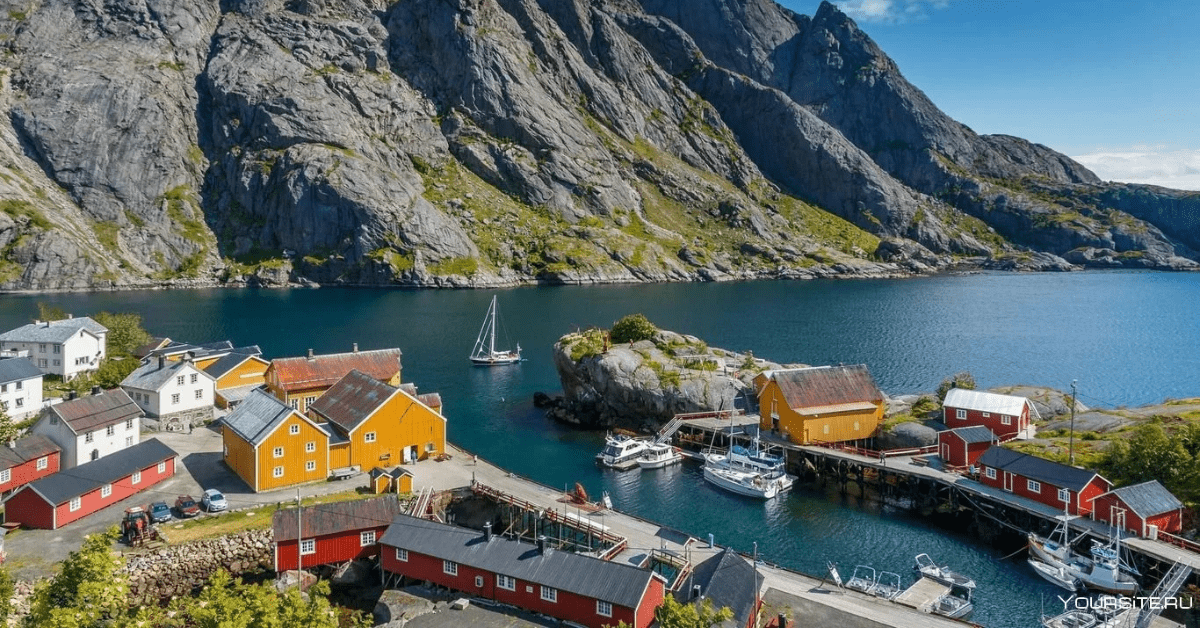
Lofoten is an island chain above the Arctic Circle with jagged peaks rising straight out of the sea and red fishing cabins on stilts and white-sand beaches that don’t look like they belong at this latitude. Photographers love it. So do hikers.
Reine and Hamnøy. These two villages at the southern end are the ones you’ve seen in every “Norway” photo. Hamnøy’s red rorbuer (traditional fishermen’s cabins) against the mountains is the classic shot.
Hike Reinebringen. The climb above Reine follows purpose-built steps and the view from the top over the villages and the water is the reward. It’s short but steep so go in dry weather and wear real shoes.
Henningsvær. Often called the “Venice of Lofoten” this village sits on small islands and is known for its football pitch perched right by the sea.
Kvalvika Beach. A roughly one-hour hike takes you to a white-sand beach surrounded by mountains.
Lofoten changes personality completely depending on when you go.
You can’t see the aurora during the midnight sun because the sky never gets dark enough. Pick your season based on what you’re after.
There’s no direct flight from the U.S. You’ll connect in Oslo or another Nordic hub and then take a regional flight to Lofoten’s small airports or fly to Bodø and take a ferry across to the islands.
Last stop and the one with the timing mistake I mentioned.
Best for: northern lights, Arctic activities and winter trips How long: 3 to 5 days
Tromsø sits well above the Arctic Circle, yet it’s an easy place to visit. It has an airport and good roads and plenty of tours and it’s one of the most reliable places in the world to see the aurora.
Chase the northern lights. Guided tours leave nightly by bus, boat or snowmobile and guides watch weather and solar activity to find clear skies. Booking a tour early in your stay gives you a second and third chance if the first night is cloudy.
Visit the Arctic Cathedral. The striking triangular church is one of Tromsø’s best-known landmarks.
Go whale watching. Whale season kicks off from Tromsø’s harbor around November.
Try Arctic activities. Dog sledding, snowshoeing and skiing are all popular and in daylight months you can hike and kayak.
Many first-timers assume the darkest coldest month is the best month. That’s partly true, but not the whole story.
The aurora season in Tromsø runs from roughly late August to early April. The peak runs from about November to February when long nights give you the most darkness. But the polar night means the sun doesn’t rise for several weeks. So daylight is very limited. If you want northern lights and some usable daylight for sightseeing and outdoor activities, late February through March is a sweet spot. Locals often call it the best winter stretch and conditions can be great for aurora in March.
After that, daylight grows fast and the midnight sun returns from mid-May. No aurora in summer but incredible light.
The northern lights depend on solar activity and clear skies. Nobody can promise them. Give yourself at least three or four nights to improve your odds.
Layers, a windproof outer shell, insulated boots and warm gloves and a hat. Many tour operators supply thermal suits. The cold is manageable if you dress right.
Couldn’t squeeze these into the top five but they’re excellent:
Still deciding? Use this quick guide.
Prices swing a lot depending on season and style. So treat these as rough guideposts not quotes.
Ways to save money:
U.S. citizens can visit Norway visa-free for up to 90 days in any 180-day period for tourism.
There are two European border systems to know about. The Entry/Exit System (EES) is now in operation and you may be asked for a photo and fingerprints at the border. ETIAS, a separate online travel authorization for visa-exempt visitors has been repeatedly delayed. As of this update, there’s no confirmed start date so don’t pay a third-party site to “apply” early. Always check the official EU ETIAS portal and Norway’s official travel site visitnorway.com before you book because this is changing.
It depends on what you want. June to August is best for fjords and hiking and the midnight sun. November to March is best for the northern lights. May and September are good shoulder months with fewer crowds and lower prices.
Seven days is enough to see two or three highlights, like Oslo and Bergen and a fjord. Ten to fourteen days lets you add Lofoten or Tromsø without rushing.
For most travelers yes as long as you plan around the big costs. Free nature scenic trains and a few well-chosen paid experiences deliver more value than a packed schedule of expensive tours.
Yes, but timing matters. In late September or March you can combine western fjord scenery (some activities run limited schedules) with northern Norway. Many travelers split these into two trips one in summer and one in winter.
Bergen and the Flåm / Nærøyfjord area give you the most variety in the least time: a charming city. A scenic train and a UNESCO fjord.
They’re different. Oslo wins for museums architecture and food. Bergen wins for atmosphere and fjord access. If you can do both.
The truth is there’s no wrong choice here. Norway rewards you for picking even one of these places and giving it enough time. If I had to choose one combo for a first trip, I’d go Oslo and then Bergen with the Nutshell route and then fly north to Lofoten in June.
Whichever you pick, book early and pack layers and leave a little space in your plans for the weather to surprise you. Norway usually does.
Which of these five is going on your list first? Drop your pick in the comments and I’ll help you plan the details.
Written By globlar.com | Author: Majid Ishfaq!